



Nurses in scrubs walking through a bright hospital corridor

    Career-Bond Industry Report

    Nursing Career & Industry Report

    There is no single correct way into nursing. Here are the three main entry points — LPN/LVN, ASN/ADN, and BSN — compared honestly, so you can choose the path that fits where you are now and where you want to go.

    3.35M

    Registered Nurses employed, 2024

    U.S. Bureau of Labor Statistics

    189,100

    Projected RN openings per year

    2024–34, including replacement needs

    $93,600 RN

    Median annual wage, May 2024

    LPN/LVN national median: $62,340

    Industry overview

    Why nursing, and why the entry point matters

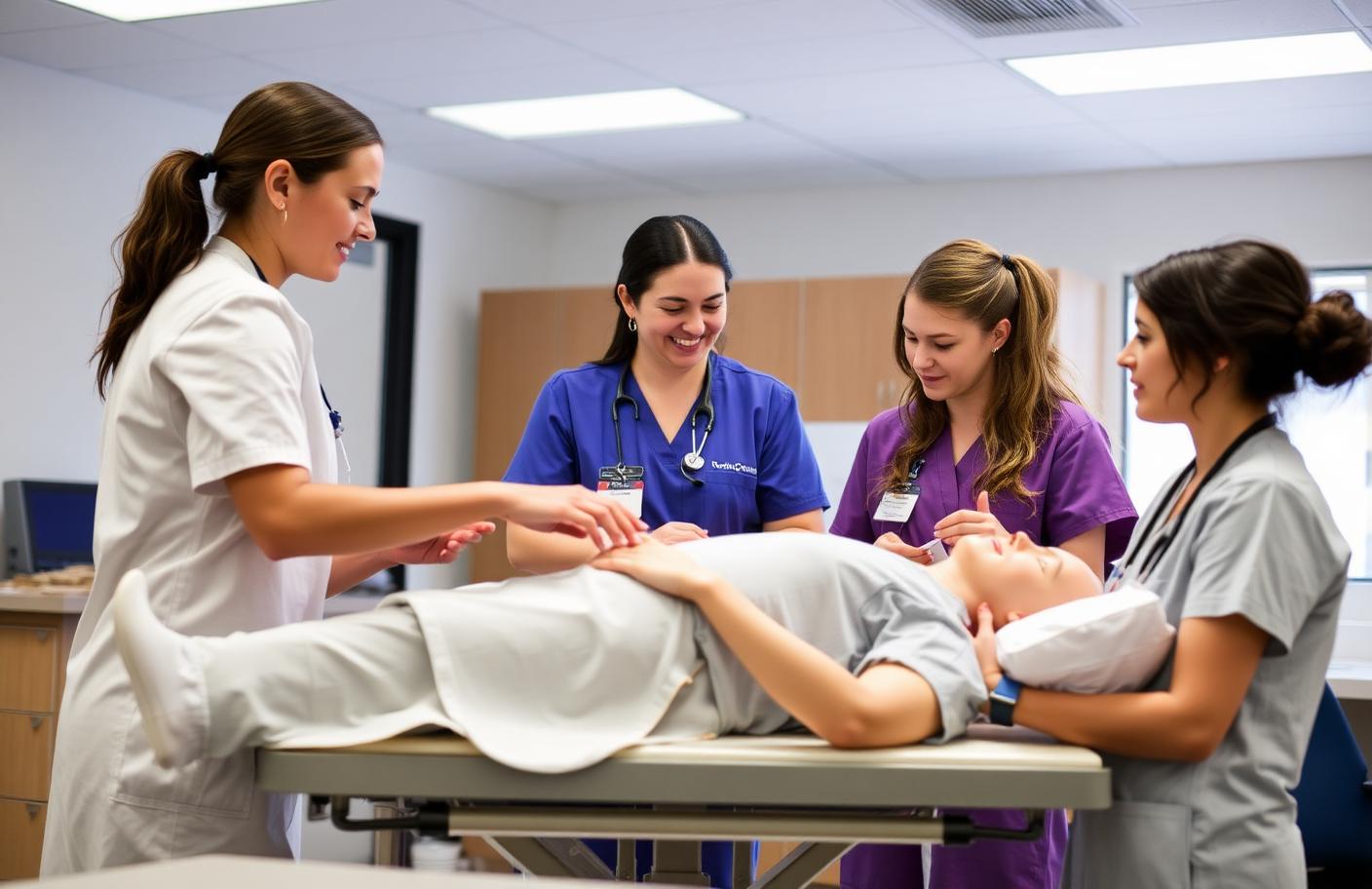
    Nursing students practicing clinical skills with an instructor in a skills lab

    Nursing is one of the largest licensed professions in the country. About 3.35 million Registered Nurses were employed in 2024, alongside roughly 658,600 licensed practical and licensed vocational nurses. BLS projects about 189,100 RN openings and 54,400 LPN/LVN openings each year from 2024 to 2034.

    Those openings include replacement needs as workers change occupations or leave the workforce — they are not all newly created positions. National wage figures are medians for the occupation, not guaranteed outcomes for any individual.

    The bigger question is not whether nursing has opportunity. It is which entry point fits your timeline, your budget, and your longer-term goals. That is what the rest of this report is for.

    • RN employment is projected to grow 5% from 2024 to 2034; LPN/LVN employment about 3%.
    • May 2024 national median annual wage: $93,600 for RNs, $62,340 for LPNs/LVNs.
    • RN is a license issued by a state board — not a degree. Both ASN/ADN and BSN graduates sit for the NCLEX-RN.
    • Nursing is often a progression: many people start with one credential and advance later.

    Projected annual openings include replacement needs and are not the same as newly created jobs. Wage figures are national medians published by BLS and should not be read as guaranteed earnings. Licensure requires satisfying the applicable state board of nursing requirements and passing the NCLEX.

    LPN vs. LVN: what's the difference?

    They are the same practical/vocational nursing level — the terminology depends on the jurisdiction.

    Most states use Licensed Practical Nurse (LPN). California and Texas generally use Licensed Vocational Nurse (LVN). Both take the NCLEX-PN, and national sources including BLS treat them as one occupational and licensure category.

    You are not choosing between two fundamentally different careers. Scope-of-practice and licensing requirements still vary by state.

    On the job

    Three ways in, one profession

    Licensed practical nurse checking a patient's blood pressure
    LPN/LVN: a comparatively faster route into licensed nursing practice.
    Associate degree nursing student studying with a laptop and textbooks
    ASN/ADN: a potentially shorter degree route toward RN eligibility.
    Bachelor of science in nursing student on a university campus
    BSN: bachelor-level nursing preparation from the outset.

    Side by side

    The three nursing paths, side by side

    RN is a license, not a degree. ASN/ADN and BSN are two different educational routes toward the same RN licensure exam and license category.

    Choose a view

    What you do
    Provides basic nursing care under the direction of RNs and physicians
    Median pay
    $62,340
    Growth
    3%
    Annual openings
    54,400
    Training route
    Practical/vocational nursing program, about 1 year per BLS
    Credential
    NCLEX-PN, then state LPN/LVN licensure if requirements are met
    Environment
    Nursing and residential care, hospitals, physician offices, home health
    Strongest fit
    People who want into licensed patient care sooner and may bridge to RN later
    What you do
    Prepares you to sit for the NCLEX-RN and practice as a Registered Nurse
    Median pay
    $93,600
    Growth
    5%
    Annual openings
    189,100
    Training route
    Associate degree in nursing, commonly around 2 academic years
    Credential
    NCLEX-RN, then state RN licensure if requirements are met
    Environment
    Hospitals, clinics, long-term care, home health, community settings
    Strongest fit
    People prioritizing time-to-RN eligibility who may complete a BSN later
    What you do
    Prepares you to sit for the NCLEX-RN with broader bachelor-level coursework
    Median pay
    $93,600
    Growth
    5%
    Annual openings
    189,100
    Training route
    Bachelor's degree in nursing, traditionally about 4 academic years
    Credential
    NCLEX-RN, then state RN licensure if requirements are met
    Environment
    Hospitals, health systems, community and population health, specialty units
    Strongest fit
    People who want bachelor-level preparation from the start and long-term academic options

    Pay figures are May 2024 national medians; growth and openings are BLS 2024–34 projections.

    Licensed practical nurse taking a patient's blood pressure in a care facility

    LPN / LVN

    Practical and vocational nursing — a comparatively faster route into licensed nursing.

    Licensed practical and licensed vocational nurses provide basic nursing care under the direction of registered nurses and physicians. Specific duties and scope vary by state and employer.

    Practical nursing programs typically take about one year according to BLS. Graduates who meet their state's requirements sit for the NCLEX-PN.

    2024 employment658,600
    Projected growth, 2024–343%
    Projected annual openings54,400
    Median annual wage, May 2024$62,340
    Typical program length (BLS)About 1 year
    Licensure examNCLEX-PN

    Bridge program length, transfer credit, and admission requirements vary by school and state. No specific bridge duration is implied.

    If getting into licensed nursing sooner matters more right now than finishing a degree first, LPN/LVN is a rational place to start — not a lesser one.

    Associate degree nursing student studying at a community college

    ASN / ADN → RN

    An associate-level nursing degree — a potentially shorter route toward RN eligibility.

    An associate degree in nursing (ASN or ADN) is one of two common educational routes toward Registered Nurse licensure. Graduates who meet state requirements sit for the NCLEX-RN.

    Programs are commonly described as around two academic years, but prerequisites, admission requirements, clinical availability, and course sequencing can extend total time.

    Typical program length~2 academic years
    Licensure examNCLEX-RN
    Resulting licenseRegistered Nurse
    RN median annual wage, May 2024$93,600
    RN projected annual openings189,100
    RN projected growth, 2024–345%

    $93,600 is the BLS national median for Registered Nurses as a single occupation. BLS does not publish separate national RN wage data by ADN/ASN versus BSN preparation.

    If reaching RN eligibility is the priority and you're open to finishing a bachelor's later, the associate route is built for exactly that sequence.

    Nursing student holding books outside a university building

    BSN → RN

    Bachelor of Science in Nursing — broader academic preparation from the outset.

    A BSN is a bachelor's-level nursing education that leads toward the same NCLEX-RN examination and RN license category as the associate route.

    Traditional programs are commonly about four academic years, with variations for transfer students and accelerated structures.

    Typical program length~4 academic years
    Licensure examNCLEX-RN
    Resulting licenseRegistered Nurse
    RN median annual wage, May 2024$93,600
    RN projected annual openings189,100
    RN projected growth, 2024–345%

    $93,600 is the BLS national median for Registered Nurses as a single occupation. There is no separate national BLS wage figure for BSN-prepared nurses.

    If you already know you want the bachelor's — and you'd rather not plan a completion program later — starting with the BSN keeps the plan simple.

    Looking ahead

    What could nursing lead to?

    Nursing tends to be a progression rather than a single, permanent decision. Depending on your credential, experience, and interests, directions people move toward include:

    • Specialty RN practice
    • Charge or lead nurse roles
    • Nursing management
    • Care management
    • Quality and patient safety
    • Nursing informatics
    • Community and public health nursing
    • Nursing education
    • Graduate nursing pathways
    • Advanced practice nursing

    Many of these roles require additional education, experience, certification, and/or state authorization. Progression is a possibility, not a guarantee.

    BLS-sourced data

    Employment, growth, openings, and wages come from the U.S. Bureau of Labor Statistics.

    No path is 'the best'

    Career-Bond supports all three routes. We explain the tradeoffs instead of steering you.

    Licensure explained plainly

    RN is a license, not a degree — and we spell out exactly what leads where.

    No paywall

    The full report is free to read. Nothing here is gated behind a purchase.

    Still not sure which nursing path fits you?

    Answer a few questions about your timeline, how much initial education you're prepared to complete, and where you want to be in five years. We'll point you to the path worth exploring first — a recommendation, not a verdict.

    Take the Nursing Path Quiz

    Looking for a different nursing or healthcare program?

    LPN/LVN, ASN/ADN, and BSN are the three main entry points, but they aren't the only healthcare programs our partner schools offer. Browse the full healthcare lineup.

    Explore All Nursing Programs

    Know your options. Now pick the one to explore next.

    Tell us where you are and what you're aiming for, and we'll match you with vetted, accredited partner schools offering the nursing path you choose.

    Find Training Options

    Data notes and disclosures

    • RN is a professional license issued by a jurisdiction after applicable requirements are satisfied. ASN/ADN and BSN are educational credentials, not licenses.
    • Completing a nursing program does not by itself produce a license. Students must satisfy their board of nursing's requirements and pass the NCLEX-PN (LPN/LVN) or NCLEX-RN (RN).
    • BLS publishes national wage data for Registered Nurses as a single occupation. There are no separate national BLS wage figures for ADN/ASN-prepared versus BSN-prepared nurses.
    • Projected annual openings include replacement needs and are not all newly created positions. Wage figures are national medians, not guaranteed earnings.
    • Program length varies. Prerequisites, admissions, course sequencing, transfer credit, clinical availability, and enrollment status can all change total duration.
    • Scope of practice and licensure requirements vary by jurisdiction. Verify that a program meets the requirements of the state where you intend to seek initial licensure.
    • Career-Bond does not determine licensure eligibility and does not guarantee admission, licensure, employment, or earnings.

    Sources

    Want this to read later?