The Skilled Tradesmen Rebuilding California
Campus Spotlight · Season 2 · Episode 2 ·
Watch the Spotlight
Summit College: the recommendation
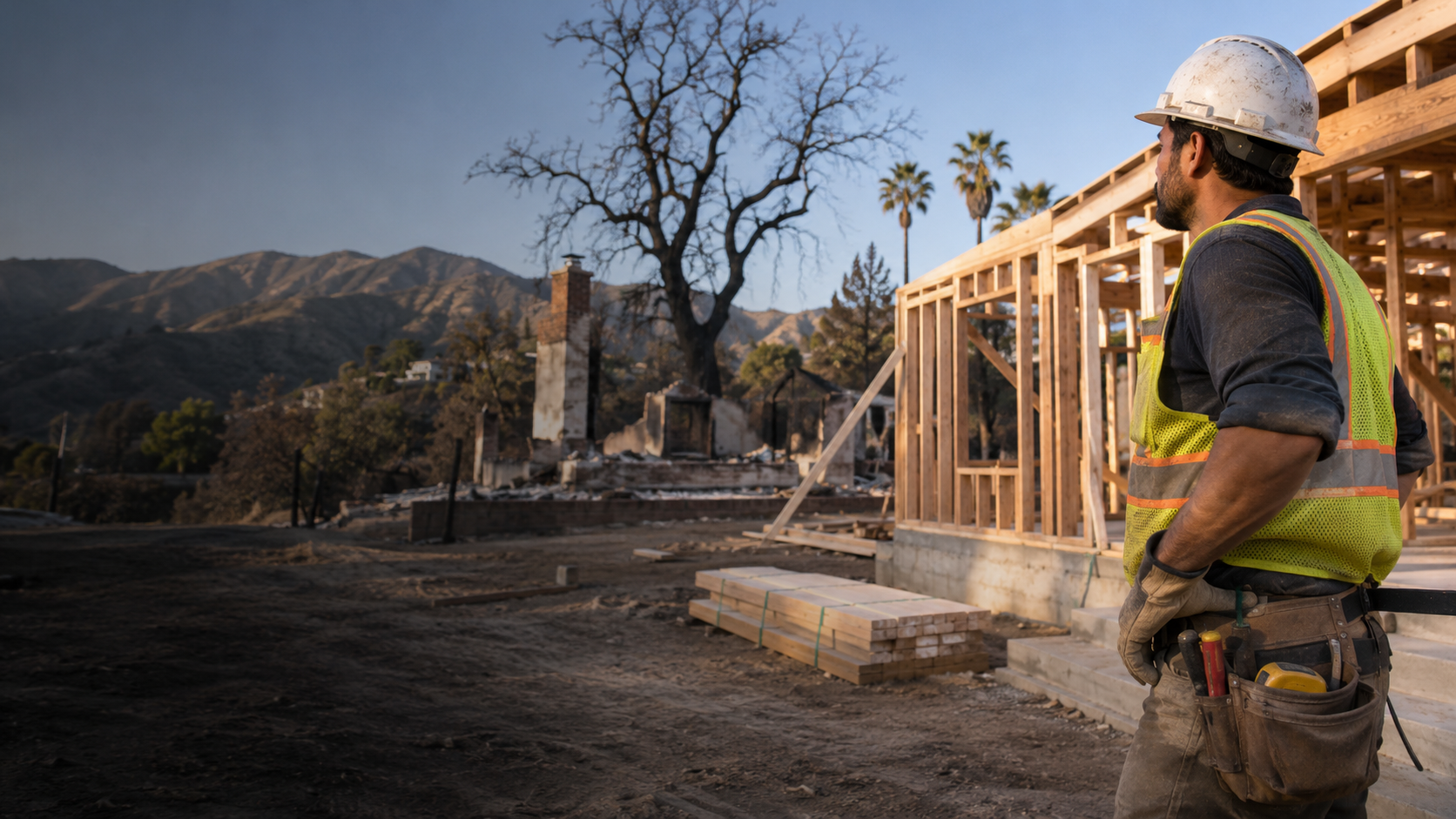
The devastating 2025 Los Angeles wildfires destroyed more than 16,000 structures, leaving Southern California facing an enormous rebuilding challenge and creating demand for skilled tradespeople.
Darius Goldman, founder of Career-Bond, explores why electricians, plumbers, HVAC technicians, and welders are essential to Southern California's future, particularly as wildfire reconstruction and preparations for the 2028 Los Angeles Olympics increase regional activity.
He spotlights Summit College for its accredited, hands-on training programs in all four trades, with campuses in San Bernardino, Santa Ana, and El Cajon.
The discussion also covers real-world job opportunities, California's electrician certification requirements, and why learning a skilled trade could be a smart career move for adults looking to start over.
Summit College campus locations
- San Bernardino, CaliforniaSan Bernardino Campus (Main Campus): 804 East Brier Drive, San Bernardino, CA 92408
- Santa Ana, CaliforniaSanta Ana Branch Campus: 1639 E. Edinger Avenue, Santa Ana, CA 92705
- El Cajon, CaliforniaEl Cajon Branch Campus: 411 N. Marshall Avenue, El Cajon, CA 92020
Full video transcript: Summit College and career training
Original transcript supplied for this Spotlight. Opinions and hiring examples reflect the recorded discussion; repeated timestamp labels are source excerpt markers, not chapter links.
(0:00 - 0:32) Remember this California fires, the Southern California fires, right? More than 16,000 homes burned last year in the California LA fires. Now, by this summer, right? July 2026, now we're in November, but by the summer, the latest report, only 122 homes have been rebuilt. So last year, there was massive fires in California, over 16,000 homes burned during those LA fires, and by this summer, only 122 have been rebuilt.
(0:33 - 0:55) 122 homes out of 16,000 homes burnt down, only 122 have been rebuilt. So why am I saying this? Because what I like to do is find news that creates opportunity. What's the opportunity here? A small city, this isn't a neighbor, this is California, 16,000 homes burnt down, only 122 have been rebuilt since that time.
(0:55 - 1:27) Another 1,900 homes are currently under construction, but 1,900 out of 16,000, that's barely a splash in the water, right? So it was a tragedy, and I don't wanna diminish that. People lost their homes, and from the news reports that I looked at, 31 people lost their lives, and that is absolutely terrible. But this is America, and we rebuild, and we go on, and we move on, right? So 16,000 homes have burned down in California, only 1,900 homes have begun construction, only 122 homes have been rebuilt.
(1:27 - 1:46) What does that say to you? That says to me over 14,000 homes in California need to be rebuilt. That's a problem, right? But it's also an opportunity, an opportunity for skilled tradesmen. So before the fires in California, LA was already short about 70,000, 70,000 construction workers.
(1:46 - 2:07) Before a single house burnt down, LA was already short, running a deficit of about 70,000 construction workers. Then the fires hit, right? As of this spring, in the Eaton fire area alone in California, only about half the families have even applied to rebuild, half. That means the biggest wave of construction work has not even started yet.
(2:08 - 2:37) What are every one of these homes that are going to be rebuilt need? Every single one will need an electrician, every single one will need a plumber, every single one will need heating and air conditioning, HVAC, the amount of opportunity right now in California for skilled tradesmen as a result of not only the Southern California wildfires, but other items I'm gonna mention is unprecedented. One rebuilt CEO said it's going to suck up plumbers and electricians like a vacuum. So for everyone that's looking to get work, follow the work.
(2:37 - 3:01) In Southern California, the work is in rebuilding after the fires, after the aftermath, all over California. So if the massive fires that are now causing a building boom and a dearth of construction workers wasn't enough, what else is going on in California right now? Southern California also has a deadline that it cannot move. The deadline is July, 2028, and it's gonna take a lot more skilled tradesmen to meet this deadline.
(3:01 - 3:06) Do you know what that deadline is for? The Olympics. California's getting the Olympics in 2028. I don't think they should.
(3:06 - 3:23) I mean, it's great for the economy, but as if the freeway traffic isn't bad enough. A study has shown that the Olympics that they're gonna have in California in 2028 will support up to 224,000 jobs across Southern California. 224,000 jobs.
(3:23 - 3:31) The Olympics are gonna create 24,000 jobs across Southern California. So it baffles me. I talk to career changers all day long.
(3:31 - 3:49) It baffles me when people say they can't find work. So what I do is, when you can't find work, I look at the news and say, okay, what's happening in the economy? What's happening in society that creates opportunities for employment? And in Southern California, you have this confluence of events. You have the wildfires that destroyed 16,000 homes.
(3:50 - 4:06) Only 122 have been rebuilt since. And you have the Olympics coming to Southern California in 2028. That's a deadline that can't be moved that will create, will support up to 224,000 jobs across Southern California, right? Los Angeles, Orange County, Riverside, San Bernardino, Ventura.
(4:10 - 4:19) This number, 224,000, it's every kind of job. Hotels, transportation, security, not just the trades, but a lot of it needs to be built, right? Side note. Now, let me be clear.
(4:19 - 4:37) They're not building brand new stadiums in California, but the amount of construction and transit and infrastructure that will take place in California in the next two years is creating what I'm calling a boom. A boom, a gold rush for skilled tradesmen. So if you're already a skilled tradesman, it's great.
(4:37 - 4:43) Go to California. If you're not, now's a great time to learn a trade. You had 16,000 homes burned down.
(4:43 - 4:59) Only 122 have been rebuilt since then. And you have the Olympics coming in 2028 with massive construction, transit, infrastructure needs to support the Olympics. The LA Convention Center alone, right? This expansion, that's going to create 15,000 jobs.
(4:59 - 5:08) And the part that gets me is because it's the Olympics, right, the games don't move. This must be completed by March, 2028. Like it must.
(5:08 - 5:14) You can't push the Olympics back. Could you imagine if someone said, hey, the Olympics is going to start. It's going to start a month later.
(5:14 - 5:25) This isn't like a home renovation product. This is the freaking Olympics in California on top of wildfires the year before, right? So they have a fixed date. Right now they're running a deficit of at least 70,000 construction workers.
(5:26 - 5:30) They have a fixed date that cannot be moved. They don't have enough workers. What does that mean to me? That means opportunity.
(5:31 - 5:43) That means it's leverage. That means there's leverage if you want to learn a trade. So like right now, this is what I'm calling right now, probably the best time and the best place to learn a skilled trade is in Southern California.
(5:43 - 5:53) We're going to kick it off. Right now, 2026, the four best trades to learn in Southern California, because of everything that's happening, the Olympics and the wildfires. You could train for these trades in months, not years.
(5:54 - 5:57) And that's why I love them. And number four is my favorite. So I'm going to save it for last, right? Let's start at the top.
(5:57 - 6:11) Welding, for people who like making physical things, metal fabrication, California, their community colleges have flagged a growing shortage of welders to rebuild homes, schools, and infrastructure. So welding is number one on my list. Two, plumbing.
(6:11 - 6:27) Plumbing is for people who like solving the problem no one else wants to touch. Every rebuilt home, the 16,000 homes that burnt down, every rebuilt home will need plumbing and plumbers are the first on the list of who's going to need to like do these rebuilds. Number three, electrician.
(6:27 - 6:35) Electricians are for people who like the circuits, right? The gadgetry, how things connect. California, this is unique. California requires state certification.
(6:35 - 6:45) Because California requires state certification, electricians are harder to replace. It's like a gatekeeping, but it makes it that much harder to replace an electrician. And number four, my favorite, HVAC.
(6:45 - 7:00) To me, that's the jack of all trades. For people who are mechanically inclined, like they like mechanical problems, figuring out why a system isn't working, HVAC, right? Heating, cooling, so important in California. And now heat pumps, which California, Southern California is paying homeowners to switch to.
(7:00 - 7:07) Southern California is paying homeowners to switch to heat pumps. Every one of these training programs could be done in months, not years. That's why I like them.
(7:07 - 7:21) So like between welding, plumbing, electrical, and HVAC, pick the one that matches how you like to work, right? So picking a trade is step one. Now you gotta pick a school. Like, how do you pick a school to learn this? Because you can't learn this on YouTube, right? You can't learn this on TikTok Live.
(7:21 - 7:30) You have to go to school. To do plumbing, welding, electrical, or HVAC, you need to go to trade school. So Southern California, tremendous opportunity, tremendous need for skilled tradesmen.
(7:30 - 7:43) Here's like the questions I would ask a school if I was picking a school, right? Number one, and this is a deal breaker. Are you accredited? Means an outside agency checks the school, governs the school. And if the school isn't like good, it'll shut it down.
(7:43 - 7:57) So there's some programs I talk about that maybe don't require an accredited school. Like some of this AI, like short courses, that's like more like, hey, four hours, let me learn something over a weekend. But if you're talking about plumbing, welding, electrical, or HVAC work, the school must be accredited.
(7:57 - 8:09) So when you find a school, these are the questions you have to ask it. Number one, are you accredited? If they're not accredited, turn around, walk away when it comes to skilled trades. Number two, is the school close to me? Skilled trades is a hands-on training.
(8:10 - 8:14) You can't do this online. You're in the workshop. You're there in person.
(8:14 - 8:28) If the school is two hours away from you, you're not gonna go every day, right? Two hours one way. So like 45 minute drive where I live, 45 minutes is the norm to like go somewhere. Like the school has to be within 45 minutes of you, right? So that's number two.
(8:28 - 8:41) And number three, and this is like for trade schools, I actually like this question. What do you teach there? If the school only teaches HVAC, great. Okay, like that's one, but look at what the most in-demand trades are right now.
(8:41 - 8:54) Welding, electrical, HVAC, and plumbing. I think a better school covers like two or three or like a great school would cover all four. Like let you find the right thing to learn based on like your interests, not what the school happens to teach.
(8:54 - 9:09) So is the school accredited? Is it local to you? And what's the breadth of their training programs? Like a great school would have HVAC, welding, electrical, and plumbing. So you don't have to choose like choose one, but like don't be hamstrung in like what you're able to learn. So, okay, there you go.
(9:09 - 9:29) So that's what I look at. That's what I think you should look at when you're trying to pick a school in California. So because this is a live and because I can't come and just give you like my criteria and then not like find an answer for it, I actually did the work and I looked, accredited schools, enough locations, and like does it cover everything? And I found a school, so I'm gonna talk about that school, the school that I like.
(9:29 - 9:37) And if you went to the school, I wanna hear it in the comments, like let me know. But I found a school, it's called Summit College, like summit, like a mountain, summit. Here's what I like about them.
(9:37 - 9:41) They're credited. So like check number one, are you credited? Yes. They've been training people since 1991.
(9:42 - 9:48) I graduated high school in 1996. So 1991, that's what, 30 years or so more. That's a long time.
(9:48 - 10:03) Are they local? The reason I picked them for this spotlight, they have three campuses, San Bernardino, El Cajon, and Santa Ana, right? So they're in San Bernardino County, San Diego County, and Orange County, right? Three counties. That's good coverage. And I'm four, and this is the big one to me.
(10:03 - 10:08) What do you teach? And what I found out was Summit teaches all four. Electrician, check. HVAC, check.
(10:09 - 10:14) Plumbing, check. Welding, check. Three campuses, four programs, all school trades, and they're accredited.
(10:14 - 10:18) Most schools teach one or two. What I liked about Summit is that they teach all four. So check.
(10:19 - 10:25) It hits my list. So it doesn't matter what you wanna do, you can do it there. That's why I like it, right? So I find one school that like covers everything I wanna talk about.
(10:25 - 10:31) I think it makes my life easier. Now, how long do these programs run? They'll run like eight to nine months. Can't learn HVAC from YouTube.
(10:32 - 10:35) You gotta show up. So there you go. That's what I came up with.
(10:35 - 10:47) Now, why are we talking about Southern California? Why are we talking about learning a skill trade in Southern California? Because California's a very unique place. They make things more difficult. California actually made becoming an electrician hard on purpose.
(10:47 - 11:05) But that's actually good news because it creates a gate, right? To do electrical work in California legally, right? Everything we talk about is like legal here, not illegal. To do electrical work for a licensed contractor in California, you have to be certified by the state. To become a certified general electrician, you need 1,000, eight hours on the job.
(11:05 - 11:12) And you have to pass the state exam, 8,000 hours. So when I was a lawyer, here's the math in my head. When I was a lawyer, they expect you to work 2,000 hours a year.
(11:12 - 11:27) If you build 40 hours a week, every week, that's 2,000 hours a week, assuming you take two weeks of vacation. So two, four, six, eight, that's four years. In California, to become a certified general electrician, they're saying you have to work four years on the job and then pass the state exam.
(11:28 - 11:32) That's a lot of work. Maybe you don't want to be an electrician. Maybe you want to just do HVAC or plumbing.
(11:33 - 11:39) But that's the requirement in California, which is funny. But while you're building those hours, you register as an electrician trainee. That generally means two things.
(11:40 - 11:51) You're enrolled in a state-approved school and you're working under a certified electrician, right? So what's the good news? Why is this actually a good thing? Because if you want to do this, it keeps people out. That's why I like it. You can't just have people climb in.
(11:52 - 12:12) That's why also there's such a dearth, absence of qualified skilled tradespeople in California. Now, what's the benefit of this? The benefit is when there's more demand, less supply, rates go up. Now, I'm not saying you're going to earn this just by going to electrician school and getting licensed, but I look at Indeed in Southern California and this is what jobs are posted at.
(12:12 - 12:14) And again, I need to be clear. I'm not the employer. I'm just reading Indeed.
(12:14 - 12:23) So I'm reading the news. But TK Electric in Orange, California, they're posting. So this is looking at Indeed in November of 2026.
(12:23 - 12:39) TK Electric in Orange, California, posted on Indeed an apprentice electrician with a year of experience. They posted that up to $40 an hour. Now, the same company, TK Electric in Orange, California, posted for a journeyman electrician, posted it on Indeed up to $50 an hour.
(12:39 - 12:51) Journeymen always do make more money though. Like, what's the lesson here? The harder it is to like get a license for something, the harder it is to like practice something, the more job security you have in that, right? The harder to get in, the more it's worth once you're in. So I'd probably just do HVAC.
(12:52 - 13:09) I like the EPA 608 certification, but if you're willing to jump through those hoops in California, journeyman electrician, they're posting TK Electric in Orange, California, today's posting $50 an hour for journeymen. So there you go. Now, here's why I think HVAC in California is probably the move for 2026.
(13:09 - 13:19) Southern California is paying homeowners. This is California, they do wonky things like that. Southern California is paying homeowners to get rid of their gas furnaces, right? We have to be clean energy.
(13:19 - 13:23) Not enough people are talking about this. It's called Go Zero. What a silly name.
(13:23 - 13:33) The South Coast Air District reopened it in the end of August. That's Orange County and big parts of LA and the Inland Empire, right? This is what this program does. This program pays.
(13:33 - 13:45) It pays homeowners to swap a gas furnace or water heater for an electric heat pump. Okay, what's a heat pump? A heat pump's a machine that heats and cools, right? It places your furnace and your AC. Two machines, one box.
(13:45 - 13:57) Now, why are they doing this? They're doing this for clean air, get rid of gas furnaces, I don't know. But who installs these, right? Who installs? Think about this. If there's an incentive to swap out gas furnaces for electric heat pumps, who installs this? Not CHATGBT.
(13:57 - 14:11) You're not gonna outsource this to Philippines. This, HVAC work, it's AI-proof, it's outsource-proof, right? It's recession-proof. Nobody in San Bernardino County is gonna skip their AC in the middle of August heat, right? So I actually like this because the barrier is lower.
(14:11 - 14:22) You just go to trade school, you get certified, you get your EPA 608 certification. There's a federal certification that says you're allowed to handle the refrigerants. And now, you can't say you have job security or job security because I don't know who you are.
(14:22 - 14:34) But like, this is where the demand is. So like, my entire thesis is follow the demand. So what are employers actually posting for HVAC right now? I looked, right? I pulled HVAC postings from Indeed November 2026, the Inland Empire.
(14:35 - 14:49) And there's a desperate need for HVAC technicians when employees start posting hiring bonuses, right? So one employer was offering a $2,000 sign-on bonus. When people are saying, I will pay you a bonus just to work for me, that's desperation. But that's not even the posting that got my attention.
(14:49 - 14:55) Here's the one. Control Temp, that's the name of the company, Control Temp in Redlands, California. Two postings, same company.
(14:56 - 15:02) They did a posting for an HVAC installer. Install HVAC, posted up to $37 an hour. They posted an HVAC technician.
(15:03 - 15:09) They posted that up to $45 an hour. Same company. And the reason I like this is it shows the ladder, right? Start as an installer, move to a technician.
(15:10 - 15:16) 37 an hour, 45 an hour, right? Same company. That's the ladder in one building. You start installing, you learn, you level up.
(15:16 - 15:24) That's why I love the skilled trades. So now about the $2,000 signing bonus. That company was White Mechanical in Riverside, California.
(15:24 - 15:38) They're posting for a lead commercial HVAC installer up to $45 an hour, plus $2,000 sign-on bonus, right? And even like when companies start offering signing bonuses, they're desperate. I'm an employer. I'm not giving you a bonus.
(15:38 - 15:44) I'm not giving you a bonus before I even met you. That's what a signing bonus is. A signing bonus is, you didn't even start.
(15:44 - 16:00) Day one, here's some extra money. That's how desperate they are, right? That's how desperate they are in California right now for HVAC technicians that White Mechanical in Riverside, California is offering a $2,000 sign-on bonus for HVAC technicians, HVAC installers. I talk to career changers all day.
(16:01 - 16:10) And what I'm advocating for is like short-term training, you know, nine months. I get a lot of questions like what's too old, right? Obviously if you're 18, don't go to college, do this instead. But like if you're 20, work in retail, not too late.
(16:11 - 16:19) What if you're 30? What if you're 40? Is 40 years old too late to learn a skilled trade? It's a good question. I get that question a lot. And I actually think the answer is the opposite of what you might expect.
(16:19 - 16:29) So my answer is no, it's not even close to being too late because it's not four years of school. It's like six to nine months. You can't go back to college at age 40 and come out at 44 and still land a six-figure office job.
(16:30 - 16:39) Like I'd say that ship has sailed. But you could absolutely learn a skilled trade in nine months, under a year. And so you're 40, you come out at 40 still, maybe you come out at 41 because you had a birthday.
(16:39 - 16:54) But here, everything you've done for the past 20 years like sort of comes with you, right? Showing up on time, dealing with customers, being responsible, solving problems, right? Like you take that skillset with you. You take that maturity with you. So no, being 40 is not too late to like start over and learn a skilled trade.
(16:54 - 16:59) And here's the part I love. When you have a little gray in the beard, like I do, right? Notice how my hair is all black. It's amazing.
(16:59 - 17:05) Thank you, mom. I got that from my mother. But when you have a little gray in the beard, people assume you've just been doing it for 30 years.
(17:05 - 17:25) Now I have been doing this for 30 years. But if you just become a tradesman and you just like go to vocational school and you learn a program, you come out with a little gray in your beard, they won't know that you've been doing it for three days as opposed to 30 years, right? So no, it's not too late, right? I think it's too late to waste another year doing nothing. I think it's too late to waste a year doing Uber and DoorDash.
(17:25 - 17:30) I think it's too late to waste a year waiting on tables. Learn a skilled trade. Own your destiny.
Explore related career paths
General career guides, not a list of programs confirmed at every campus.